*This article addresses Turkish law exclusively. Doğru Kanzlei advises on Turkish law under § 207 BRAO and does not advise on German domestic law.*
You are living in Germany, the Netherlands, or the UK. You do not know where to begin. And somewhere in the back of your mind, a question forms: is this even legal? Can this be reversed?
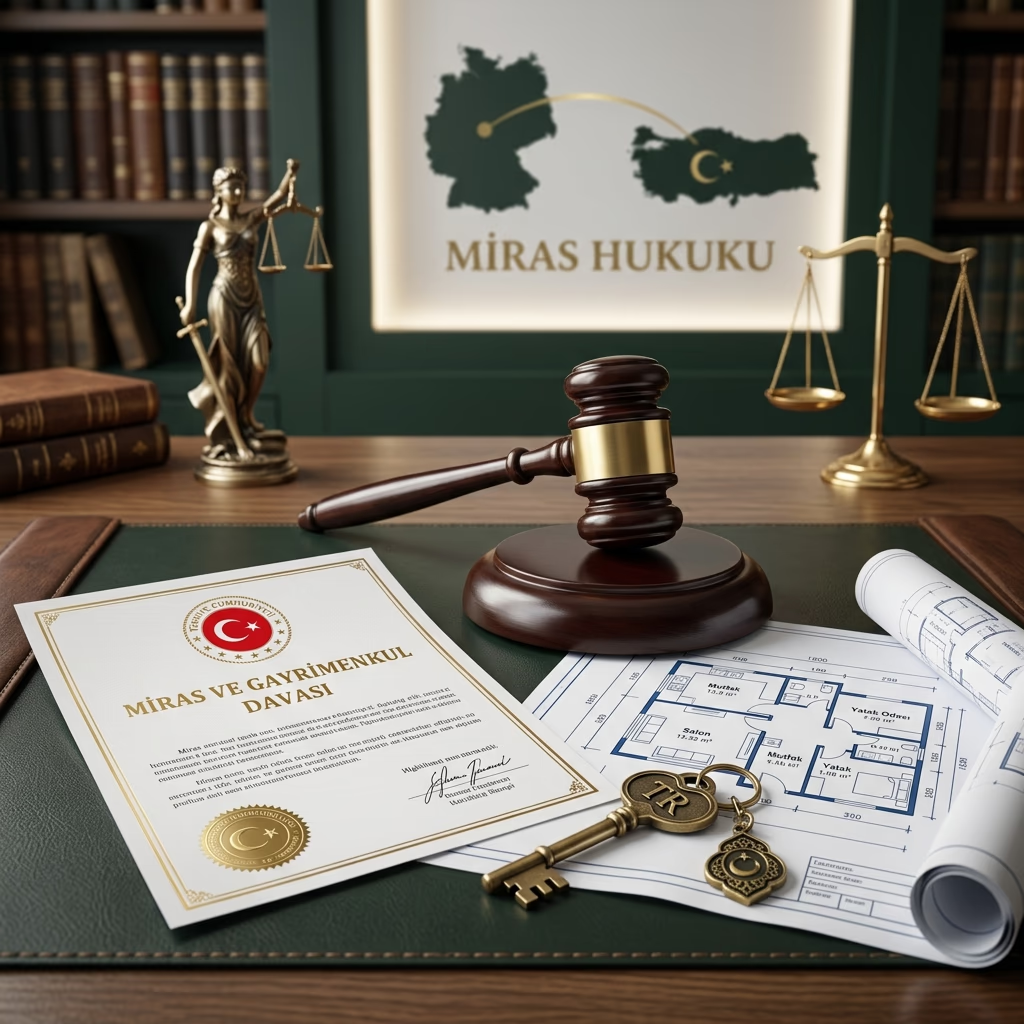
The answer, under Turkish law, is yes. What you are describing has a name: muris muvazaası — testator collusion, or in plain terms, inheritance fraud through a sham property transfer. And Turkish law gives heirs a direct legal remedy: the tapu iptal ve tescil davası — the deed cancellation and re-registration lawsuit. You can file it from Germany without travelling to Turkey once.
What Is Muris Muvazaası?
Muris muvazaası refers to a situation where a person transfers property to a favoured heir before death, disguising a gift as a sale in the official title register. The title deed shows a purchase agreement. The stated price may look plausible on paper. But no real payment was made — or an amount far below market value changed hands under duress or as a token gesture.
This is not a rare or obscure legal dispute. It is so common in Turkish society that the Yargıtay (Turkish Court of Cassation) issued a landmark Grand Assembly ruling specifically addressing it in 1974 — Yargıtay İçtihadı Birleştirme Kararı 01.04.1974, E. 1974/1, K. 1974/2 — and that ruling remains binding on every Turkish court today.
The relevant legal framework:
Why Overseas Heirs Are Hit Hardest
In cases seen at Doğru Kanzlei, a consistent pattern emerges: muris muvazaası disproportionately affects families where one or more heirs live abroad. The structural reasons are straightforward.
Distance creates a blind spot. A child living in Mannheim, Rotterdam, or Stockholm has no way to monitor property movements in Ankara. The sibling living in Turkey has daily access to the parent, the notary, and the title register.
Information asymmetry. Many second and third-generation diaspora heirs have limited knowledge of the Turkish title register system (tapu). They may not even know whether their parents owned property, or in whose name.
Family pressure and narrative control. The argument most often used is care — "I stayed here, I looked after them, this is my compensation." This is both an emotional lever and a legal claim that shapes how the transfer is presented after the fact.
Late discovery. The overseas heir learns about the transfer weeks or months after the death, through informal family channels. By then, the sibling may have already moved to sell the property.
⚠️ Important: The moment you learn of the death, check the Turkish title register. A Turkish lawyer can pull the current title status through UYAP within hours. Every day of delay increases the risk that the property is sold to a buyer you cannot easily challenge.
The Blue Card Trap
A specific problem affects heirs who hold a Mavi Kart (Blue Card) — the document issued to former Turkish nationals who acquired another citizenship and formally renounced their Turkish one.
What the Mavi Kart guarantees in principle: Blue Card holders retain the same inheritance rights as Turkish citizens. They can inherit, own Turkish property, hold bank accounts in Turkey, and file lawsuits in Turkish courts.
What goes wrong in practice:
*Problem 1 — Civil registry not updated.* When a person gives up Turkish citizenship, this change must be correctly recorded in the Turkish civil registry (Nüfus Müdürlüğü). In practice it often is not — or only partially. The result: courts and banks see an unclear or inconsistent status and refuse to cooperate until additional documents are produced.
*Problem 2 — The opposing party exploits the ambiguity.* In contested cases, the defendant's lawyer challenges the Blue Card holder's standing to sue, requesting additional documentation to prove eligibility. This takes months — months during which the property can be sold.
*Problem 3 — Bank access.* Turkish banks are notably cautious about Blue Card holders. While the overseas heir is assembling the required paperwork, the sibling with Turkish citizenship can access the deceased's accounts immediately.
The preventive solution: If your parents are elderly or unwell and you hold a Blue Card, check now that your status is correctly registered in the Turkish civil registry. Confirm your Mavi Kart is current. Have a Turkish lawyer check the title register on your parents' assets. These are twenty-minute tasks that can prevent years of litigation.
How to Prove Muris Muvazaası
The plaintiff bears the burden of proving that the transfer was a sham. According to Yargıtay Grand Assembly ruling 2010/1-295, heirs are exempt from the normal document restriction and may use any type of evidence.
The Yargıtay 1st Civil Division applies a consistent checklist of indicators:
| Indicator | What It Looks Like |
|---|---|
| Gross price-to-value disparity | Property worth €200,000, sale price €20,000 |
| Buyer lacked financial means | Sibling was unemployed or in debt at the time |
| Deceased continued living in the property | Parent stayed in the home after the "sale" |
| Close family relationship | Transfer was to a child or grandchild |
| Overseas heirs as a sign of deliberate exclusion | German-resident children kept uninformed |
| Advanced age or illness of deceased | Transfer happened during deteriorating health |
| No economic reason for the sale | No debts, no financial pressure to sell |
Three or four of these indicators together are typically sufficient for the Yargıtay to uphold a deed cancellation.
Usable evidence: Expert valuation of the property at the time of transfer, bank records showing no payment was made, witness statements from neighbours, relatives, and family friends, family correspondence (messages, letters, emails), health records of the deceased, and the deceased's continued presence in the property.
The Emergency Step: Ihtiyati Tedbir (Title Freeze)
The single most important first action in any muris muvazaası case is applying for an ihtiyati tedbir — a court injunction that freezes the Turkish title register and prevents the property from being sold while your case is pending (Turkish Code of Civil Procedure, HMK Arts. 389–399).
Why is it so urgent? The main court case takes 1.5 to 2 years at first instance, another year or more on appeal. During that window, the property can be sold. If it is sold to a buyer who acquires it in good faith — unaware of the inheritance dispute — reclaiming it becomes dramatically harder, sometimes impossible under TMK Art. 1023.
How to apply: The application goes to the Asliye Hukuk Mahkemesi (Civil Court of First Instance) at the location of the property. You need a death certificate, proof of heirship, a current title extract, and a brief statement of urgency. The court typically decides within one to three business days. Critically, the application can be made before the main lawsuit is filed — and even before a full inheritance certificate (veraset ilamı) has been issued.
⚠️ Important: If you suspect muris muvazaası, apply for the ihtiyati tedbir immediately after the death — do not wait for the full documentation to be in order. A title freeze obtained on day one protects you throughout the entire case.
Chain Sales: When the Property Has Already Been Sold On
A particularly difficult scenario: the sibling who received the property through a sham sale then sells it to a third party — sometimes a relative, sometimes a business partner, often at below-market price — specifically to make the title harder to challenge.
The Yargıtay 1st Civil Division has addressed this in settled case law: if the third-party buyer was not acting in good faith at the time of purchase — meaning they knew or should have known about the inheritance dispute — then the chain sale can also be cancelled.
Signs that the third party was not acting in good faith: they are a close relative or business associate of the defendant, the purchase price was significantly below market value, the transfer happened shortly after the death or during ongoing proceedings, the property was not advertised and changed hands without any market process.
This is precisely why the ihtiyati tedbir must be filed immediately — it freezes the register before a chain sale can happen.
The Bank Account Problem
Muris muvazaası rarely stays limited to property. In many cases, the favoured heir also had access to the deceased's bank accounts and emptied them before or shortly after the death.
Civil route — Damages (TBK Art. 49): A damages claim for the amount corresponding to your inheritance share of the account balance. This is filed before the civil court alongside or after the deed cancellation case.
Criminal route — Breach of trust (TCK Art. 155): If the sibling abused a power of attorney or used account access they were not entitled to, this constitutes Güveni Kötüye Kullanma (breach of trust) under Turkish criminal law. A formal criminal complaint is filed with the Cumhuriyet Başsavcılığı (Public Prosecutor's Office) at the location of the bank.
Strategy: Both routes are pursued in parallel. The criminal complaint applies significant pressure — and in practice, it often moves the other party toward an out-of-court settlement that resolves the bank account issue faster and at lower cost than full civil litigation.
A Typical Case (Anonymised)
A client based in Stuttgart contacted Doğru Kanzlei three weeks after her mother's death. She had just learned that the family apartment in Ankara — where her mother had lived until her final days — had been transferred to her brother's name six years earlier. The title deed showed a sale for an amount equal to roughly one-fifth of the apartment's market value. There were no bank records of payment. Her mother had never mentioned selling the apartment.
First action: an ihtiyati tedbir application was filed within 24 hours and granted two days later. The register was frozen.
The deed cancellation case was then built around four Yargıtay indicators: the price-to-value gap, the absence of any payment records, the mother's continued residence in the property, and a neighbour witness who confirmed the mother had spoken of the apartment as "still hers" in the year before her death.
The first-instance court ruled in the client's favour. She had not set foot in Turkey once during the entire proceedings.
Doğru Kanzlei: Direct Representation — No Middlemen
Muris muvazaası cases are among the most complex and financially significant proceedings in Turkish inheritance law. They require a lawyer who can appear before Turkish courts, command the evidence strategy, file an emergency injunction within hours, and genuinely understand the diaspora situation — including the Blue Card complications that Turkey-based firms often overlook.
Doğru Kanzlei is admitted to practice before Turkish courts through full membership with the Ankara Bar Association (Sicil No: 47068) and is registered with the Karlsruhe Bar Association under § 207 BRAO. Av. Hasan Doğru handles deed cancellation lawsuits, damages claims, and criminal complaints directly — without cooperation partners, with real-time monitoring of all deadlines and title movements through the UYAP court system.
For clients in Germany, the Netherlands, or the UK, this means: no travel to Turkey required, one contact for the entire process, emergency ihtiyati tedbir when every hour counts, and civil and criminal proceedings coordinated from a single hand.
Contact Doğru Kanzlei on WhatsApp →
This guide is also available in Turkish:
Mirastan Mal Kaçırma (Muris Muvazaası): Tapu İptal Davası Rehberi →
And in German:
Muris Muvazaası: Wenn Erben ihr türkisches Erbe verlieren — Tapu Iptal Klage →