Many powers of attorney for Turkey fail due to choosing the wrong procedure. This guide explains exactly what you need to know about the consulate, notaries, and apostilles to ensure your documents are legally valid.
- Consulate vs. German Notary: Which route is better for your specific case?
- Apostilles and sworn translations: When are they strictly required?
- Avoid delays: The most common reasons documents are rejected in Turkey
Av. Hasan Doğru · German & Turkish · Mannheim & Ankara
Legal notice: This article addresses Turkish law exclusively and is for general information only. Doğru Kanzlei advises on Turkish law and public international law under § 207 BRAO and does not advise on the domestic law of any other country.
This is precisely where a recurring problem arises. The document is executed, sent to Turkey — and rejected by the land registry or the court. The cause is almost always the same: the wrong route was chosen, or a document, an authority, or a photograph was missing. And it usually comes to light on the very day the transaction was to be completed — a new appointment, a new cost, and often a lost time limit.
This guide is the hub page of our power-of-attorney cluster. Details on form requirements, title-deed wording and fees are linked from the relevant sections.
1. Two routes — and they are not interchangeable
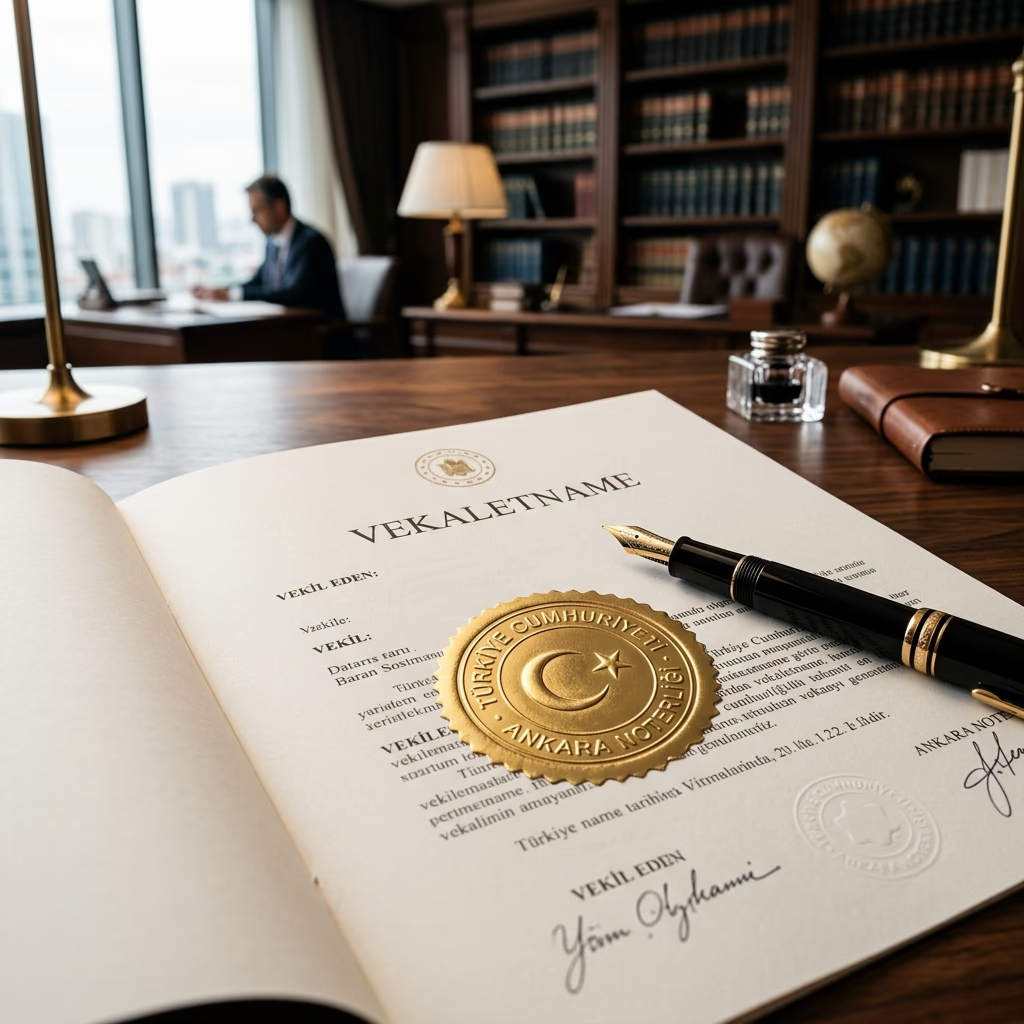
Route 1 — Turkish Consulate General. The consulate holds notarial powers. A power of attorney executed there has the same effect as one executed before a Turkish notary; no apostille or translation is required, and the deed is recorded in the Turkish notaries' system.
Route 2 — Notary abroad + apostille + sworn translation. A notary in your country of residence certifies your signature; an apostille is then obtained from the competent authority (in Germany, usually the President of the Regional Court), and the document is translated into Turkish. Notarial certification of the translation in Turkey is generally required.
The critical point: these two routes are not full alternatives. Land registry transactions are in practice handled through a consular power of attorney. A foreign notarial document may be rejected on formal grounds: Turkish law requires a photograph and specific wording for certain types of authority, whereas a notary abroad as a rule only certifies that the signature is genuine.
Practical rule: for property, vehicle and divorce matters, consider the consular route first. For other matters — estate administration, litigation authority, banking — the notary route generally works without difficulty and requires no waiting for an appointment.
| Criterion | Consular route | Notary abroad + apostille |
|---|---|---|
| Apostille | not required | required |
| Sworn translation | not required | required |
| Photograph | done on site | problematic in practice |
| Acceptance for property / vehicle / divorce | smooth | risky |
| Duration | with an appointment: one day | usually one to three weeks |
| Waiting time for an appointment | yes (sometimes weeks) | no |
2. The consular route: who, with which identification?
The rules below come from the guidance of the Turkish consulates general. Because there can be differences between consulates, check the current page of the consulate responsible for you before booking an appointment.
The single most important rule on identification. Powers of attorney for land registry transactions, vehicle sales and divorce may only be executed on presentation of the Turkish identity card (Nüfus Cüzdanı) or the Blue Card (Mavi Kart). This is the single most common cause of failure. Many attend with a valid passport and are turned away. Turkish nationals need the current identity card; those released from Turkish citizenship need the Blue Card. For other types of power of attorney (inheritance, litigation, banking) practice is more flexible — but the identity card or Blue Card is still the safest choice.
Corporate powers of attorney. For powers of attorney granted on behalf of companies operating in Turkey, the originals of the commercial register extract and the signature circular must be presented. Copies are not accepted.
Persons under guardianship. For persons with intellectual disabilities, a power of attorney may only be granted by a guardian appointed by a Turkish court. The original decision must be presented, or the guardianship must be recorded in the civil registry extract.
⚠️ Important: A guardianship or deputyship order issued abroad does not satisfy this requirement directly. Recognition of a foreign guardianship decision in Turkey is a separate procedure — for families with a relative under guardianship abroad, this is the most common obstacle.
Elderly persons. Persons of advanced age, or those in whose case doubts as to capacity may arise, must present an original neurological report. Recommendation: where the grantor is over 70, obtain a current report before the appointment.
Persons who do not speak Turkish. For all consular notarial acts, a sworn translator from the consulate's own list must attend. A translator brought by the party, or a Turkish-speaking relative, will not be accepted. This is relevant above all for the second and third generation, non-Turkish spouses, and non-Turkish nationals with assets in Turkey.
3. The notary route
The process generally takes one to three weeks — with no waiting for an appointment. All form requirements (photograph, witnesses, translator's note, medical report from age 65) are covered in the form requirements article.
4. Which authorities must be included?
The second most common cause of rejection is an incomplete list of authorities. Turkish law requires an express special authority for certain acts:
Later additions are not possible; a new power of attorney must be executed.
⚠️ Important: A frequent scenario: a power of attorney is executed for an inheritance matter, but the authority to disclaim the inheritance is omitted. If the estate later proves to be overindebted, the disclaimer period — three months under Turkish law — is already running, and the attorney cannot act.
5. Photograph
For certain types of power of attorney — particularly property and divorce powers — a photograph must be affixed and sealed. On the consular route this is done on site; bring a current biometric passport photograph. On the notary route the photograph is problematic; a colour scan is not accepted by the Turkish land registry. Details: form requirements.
6. The seven most common mistakes
7. Revoking a power of attorney (Azilname)
A power of attorney may be revoked at any time. The revocation (Azilname) must be executed by the same route — consulate or notary plus apostille — and notified to the institutions where the attorney may act.
⚠️ Important: Revocation takes effect against an institution only upon receipt there — not upon execution of the instrument. Start the revocation on the day the transaction is complete; an un-revoked power of attorney remains effective for years.
8. Who should draft the text?
The consulate and the notary record the document but do not take responsibility for its content. If the text is incomplete, it will nonetheless be executed; the problem emerges only when the document is used in Turkey. Drafting by a lawyer familiar with the specific transaction avoids the need for a second power of attorney.
How Doğru Kanzlei handles this
Doğru Kanzlei drafts the power-of-attorney text to the scope of your specific transaction and determines with you whether the consular route or the notary route is right for your matter. Once the document reaches Turkey, we carry out the transaction ourselves — the person who writes the text is the person who appears before the Turkish land registry or court.
Av. Hasan Doğru is admitted to both the Ankara Bar Association (reg. no. 47068) and the Karlsruhe Bar Association (§ 207 BRAO) and is listed as an expert for Turkish law with the Mannheim Local Court. Representation before Turkish courts and authorities is handled directly, without a local correspondent firm in between.
Request a Case Review with Doğru Kanzlei →
Related reading
This guide is also available in Turkish: Almanya'dan Türkiye için vekaletname →
And in German for German-speaking family members or advisers: Vollmacht für die Türkei: Leitfaden →

Done-for-you power of attorney process
We prepare your Turkey power of attorney with you
Use the WhatsApp intake form to explain what the document is for. Hasan Doğru checks the route, wording, apostille, translation and next steps.
What we handle
- Route check: Turkish consulate or German notary with apostille
- Purpose-specific Turkish wording for property, inheritance, bank, court or authorities
- Next-step coordination until the document can be used in Turkey
German, Turkish and English · Turkish law · Mannheim & Ankara