Send us the key facts via WhatsApp. We review the Turkish-law side, the documents needed and the next procedural step.
- SGK: check early before deadlines or documents become a problem
- BES: check early before deadlines or documents become a problem
- Pension: check early before deadlines or documents become a problem
Turkish family law · Mannheim & Ankara
LEGAL NOTICE:This article addresses Turkish law and private international law exclusively and is for general information only. Av. Hasan Doğru advises and represents clients exclusively in Turkish law and private international law (§ 207 BRAO). For any question about Germany's Versorgungsausgleich (pension equalization) system, we strongly recommend consulting a lawyer licensed in Germany — the German-law explanations in this article exist only to explain the contrast with Turkish law and are not German-law advice.
This guide explains, in plain language, what actually happens to a Turkish SGK, Bağ-Kur, or private pension (BES) when you divorce — and how that compares to what happens to a German statutory pension under Versorgungsausgleich.
The Core Difference, in One Sentence
Under German law, pension entitlements built up during the marriage are automatically split 50/50 between the spouses (Versorgungsausgleich). Under Turkish law, the pension entitlement itself — the personal right to receive a monthly SGK, Bağ-Kur, or Emekli Sandığı pension — generally stays with the spouse who earned it and is not split.
This isn't a minor technicality. It's the exact point where cross-border families most often get it wrong — in both directions.
The Pension Systems That Show Up in Turkish-German Families
Bi-national or diaspora families typically have more than one retirement system in play at once:
How each of these is treated at divorce depends on two separate questions that people frequently conflate: which country's law applies, and which pension system is actually involved.
Turkey's Starting Point: The Participation-in-Acquired-Property Regime
Since 1 January 2002, unless spouses have agreed otherwise, Turkey's default marital property regime has been edinilmiş mallara katılma rejimi — participation in property acquired during the marriage (Türk Medeni Kanunu, TMK, Art. 218–241). In simple terms: any asset acquired during the marriage through work, income, or savings is, in principle, subject to an equalization claim (katılma alacağı) when the marriage ends.
TMK Art. 219 defines "acquired property" (edinilmiş mal) broadly — it explicitly includes earnings from work and payments made by social security institutions and similar bodies.
TMK Art. 220 provides the counterpart: "personal property" (kişisel mal) — property to whose acquisition the other spouse contributed nothing, either through effort, contribution, or the marital division of labor.
The Key Point: Why the Pension Entitlement Itself Stays Personal
This is where Turkish law diverges most sharply from German law. Turkish case law (Yargıtay) treats the ongoing pension entitlement itself — the personal right to eventually receive a monthly SGK, Bağ-Kur, or Emekli Sandığı pension — as a right that is "strictly personal" (kişiye sıkı sıkıya bağlı). It cannot be transferred, assigned, or partially allocated to the other spouse — unlike Germany's Versorgungsausgleich, which does exactly that.
⚠️ Important — this is the single most common misunderstanding we see in practice. Clients familiar with the German system often assume their Turkish SGK or Bağ-Kur pension will automatically be "split 50/50" the way it would be in Germany. Under Turkish law, that assumption is wrong. The entitlement itself stays with the spouse who earned it. What can become relevant to the property division is money that has already been paid out — not the ongoing pension right.
What Actually Can Become Relevant
The dividing line isn't "pension yes or no" — it's between the ongoing entitlement and amounts already paid out:
An honest note on legal uncertainty:exactly what portion of a lump-sum bonus or BES payout corresponds to the marriage period, and how it's valued, is fact-specific and shaped by ongoing case law rather than a fixed formula. This article states the general rule correctly but is not a substitute for a case-specific assessment.
Turkish Law vs. German Versorgungsausgleich, Side by Side
| Aspect | Turkish law (TMK) | German law (VersAusglG) — for contrast only |
|---|---|---|
| Ongoing pension entitlement (SGK/Bağ-Kur or German statutory pension) | Stays personal property — not split; treated as a strictly personal right | Automatically split 50/50 (Versorgungsausgleich), regardless of who actually paid in |
| Legal basis | TMK Art. 218–241, especially Art. 219, 220, 236 | VersAusglG (in force since 1 September 2009), with § 1587 BGB as the underlying substantive rule |
| Is the split examined automatically? | No — Turkish law has no mechanism equivalent to Versorgungsausgleich | Yes — carried out by the court alongside the divorce, unless excluded by notarial agreement |
| Amounts already paid out during the marriage (bonus, BES) | The portion tied to the marriage period can be factored into the katılma alacağı claim — fact-dependent | Generally not a separate issue, since it's already captured by the Versorgungsausgleich system |
| Can spouses contract out? | Yes, via a marital property agreement (Mal Rejimi Sözleşmesi) before or during the marriage | Yes, via a notarial agreement (§ 8 VersAusglG) |
| Limitation period | 10 years from the date the divorce becomes final (TMK Art. 178) | A separate application can still be filed even after the divorce proceeding has concluded |
What This Means If You're a Turkish National Divorcing in Germany
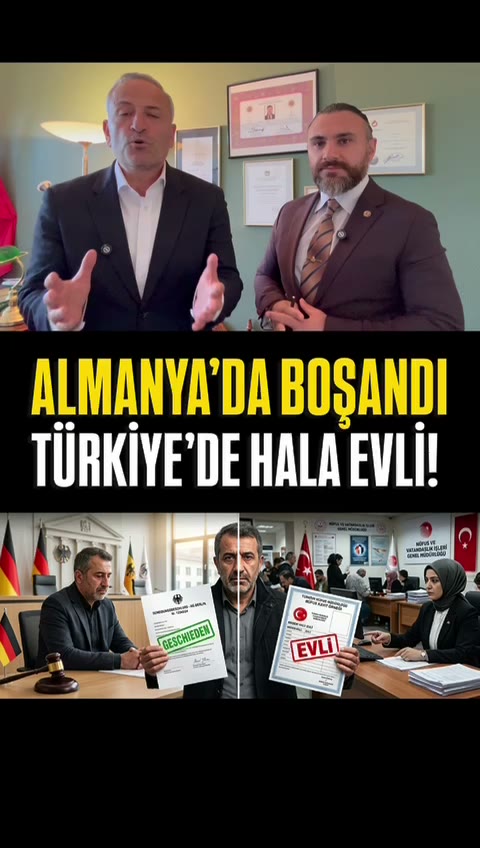
This is where it gets concrete for many clients: if a divorce takes place in Germany under German divorce law, the German family court generally carries out a Versorgungsausgleich — even if both spouses are Turkish nationals. Under current German legal commentary, Turkish pension entitlements can, in principle, be factored into that assessment too, but subject to fairness (Billigkeit) considerations — particularly where a foreign asset is involved that would not be split under the law that actually governs it (here: Turkish law).
⚠️ This question is governed entirely by German law. Whether, how, and to what extent your Turkish SGK or Bağ-Kur pension gets factored into a German Versorgungsausgleich is a decision for a lawyer licensed in Germany, or the German family court — not us. We present this contrast here purely so you understand why your Turkish pension and your German pension might be treated completely differently within the same divorce, not as German-law advice.
Conversely: if the divorce takes place in Turkey (or a German divorce decree is recognized or enforced there via Tanıma/Tenfiz — see our Tanıma-Tenfiz recognition guide), no Versorgungsausgleich-equivalent process applies at all. Only the property-division analysis under TMK Art. 218 et seq. applies — with the same split described above between the ongoing entitlement (personal) and amounts already paid out (potentially acquired property).
How the Process Actually Works in Turkey, Step by Step
Step 1 — Take inventory: which pension systems are involved (SGK, Bağ-Kur, BES, OYAK, Emekli Sandığı)? Were any amounts already paid out during the marriage?
Step 2 — Allocate contribution periods: for each relevant payout, determine what proportion corresponds to contribution periods before, during, and after the marriage.
Step 3 — Trace the source of contributions: were the contributions funded from marital income, or from a clearly personal source (inheritance, gift, pre-marriage savings)?
Step 4 — Fold it into the katılma alacağı claim: the relevant portion is included, together with the rest of the marital estate, in the overall calculation under TMK Art. 236.
Step 5 — Check the deadline: the 10-year limitation period under TMK Art. 178 starts running from the date the divorce becomes final — regardless of when the pension payment itself actually occurred.
Timeline and Cost — Realistic Numbers
| Scenario | Realistic timeline |
|---|---|
| Katılma alacağı claim with no pension component, uncontested | 8–14 months |
| Katılma alacağı claim including a BES/bonus component requiring expert valuation | 12–20 months |
| Combined with recognition (Tanıma/Tenfiz) of a German divorce decree | an additional 4–8 weeks to several months, depending on the service-of-process route |
| Cost item | Approximate amount |
|---|---|
| Court fee (proportional to claim value, property-division case) | proportional to claim value, under Turkish court-fee rules |
| Expert valuation (bilirkişi) for BES/pension-portion assessment | typically a few hundred to a few thousand TL, depending on complexity |
| Certified translation of German pension documents | approx. €150–300 per document package |
| Attorney fee | by individual agreement |
Worked Example: What a Mixed Pension Situation Looks Like in Practice
A typical case from our practice, lightly modified for illustration: Mr. Y., a Turkish national, worked as an employee in Germany for 14 years and built up a German statutory pension entitlement there. Before emigrating, he had already paid 6 years of SGK contributions in Turkey. During the couple's twelve-year marriage, he also paid into a Bireysel Emeklilik (BES) private pension plan, and received a lump-sum payout of roughly €18,000 when the contract ended — the entire contract term fell within the marriage.
Turkish side: The ongoing SGK entitlement from the 6 pre-emigration years stays entirely personal property — it was earned before the marriage, and as a strictly personal right it wouldn't be split in any case. The €18,000 BES payout, on the other hand, was accumulated entirely during the marriage and funded from marital income — so it can, in principle, be treated as acquired property and factored into a katılma alacağı claim, giving the wife a calculated equalization claim of roughly €9,000, subject to accounting for the couple's other marital assets and liabilities.
German side (for context only, not a German-law assessment): The portion of the German statutory pension entitlement built up during the marriage would, in principle, be subject to Versorgungsausgleich in a German divorce proceeding — independently of the Turkish BES payout, which is treated as a separate asset. Whether and how pre-marriage portions or foreign assets factor in is a question governed entirely by German law.
The takeaway: two completely different calculation paths for two different assets, within the same marriage. This is exactly why, in mixed cases, we recommend running the Turkish katılma alacağı analysis and the German Versorgungsausgleich analysis separately, but with each side aware of the other's outcome — otherwise you risk double-counted claims on one side and missed claims on the other.
Planning Ahead: Can Pension Treatment Be Fixed by Agreement?
If both spouses already know they'll be building assets in both countries, planning ahead is possible:
In Turkey: a marital property agreement (Mal Rejimi Sözleşmesi) can be signed before a notary, either before or during the marriage. It can modify the default property regime in whole or in part — for example, by agreeing on separation of property (Mal Ayrılığı Rejimi) specifically for assets like BES contracts or occupational pensions.
In Germany: Versorgungsausgleich can be excluded in whole or in part by notarial agreement (§ 8 VersAusglG) — this requires a lawyer or notary licensed in Germany.
Our practical recommendation: if both spouses have or will have assets in both countries, early, coordinated advice pays off — us for the Turkish side, a German family lawyer for the German side. Setting this up mid-divorce, once things have turned contentious, is far harder.
What Evidence to Gather — and Why to Start Early
A katılma alacağı claim involving a pension component lives or dies on documentation. From our practice, we recommend gathering the following as early as possible — ideally as soon as separation becomes a real possibility:
⚠️ Timing matters: the longer you wait, the harder it becomes to cleanly document old contribution periods and trace where individual payments came from — particularly for accounts closed long ago or employers that no longer exist. Start gathering documents as soon as separation looks likely, not once litigation is already being prepared.
The Three Misunderstandings We See Most Often
Misunderstanding 1 — "My Turkish pension gets split 50/50 automatically, because that's how it works in Germany." Wrong. The entitlement itself stays personal property.
Misunderstanding 2 — "If the pension itself isn't split, my ex-partner gets nothing from it at all." Also too broad — amounts already paid out during the marriage (retirement bonus, BES payout) can absolutely become relevant.
Misunderstanding 3 — "Because Turkey doesn't split pensions, I don't have to give up anything from my German pension either." That's decided entirely by German law and a German lawyer — the Turkish rule has no automatic bearing on it.
⚠️ The most expensive mistake: clients who assume "a pension is a pension" and both countries treat it the same way either miss a legitimate katılma alacağı claim for BES or bonus payouts already received in Turkey, or underestimate what's actually at stake in a German Versorgungsausgleich process. Both should be assessed separately but in coordination — with a Turkish lawyer and, where needed, a German lawyer working together.
Common Scenarios We See in Practice
Not every case looks like the worked example above. A few recurring patterns we regularly encounter:
Short marriage, long career: if the marriage lasted only a few years, naturally only a small slice of a long career falls within the marriage period — so any potential acquired-property portion from paid-out amounts stays correspondingly small. The ongoing pension entitlement itself remains unaffected regardless of how long the marriage lasted.
One spouse never worked in Turkey: common in bi-national marriages where one partner worked exclusively in Germany. Here the only Turkish-side question is whether, and to what extent, the other spouse built up Turkish pension value (SGK, Bağ-Kur, BES) — the German side is irrelevant to the Turkish analysis and belongs entirely to the German proceeding.
Both spouses worked in both countries: the most complex, but far from rare, scenario. Here we recommend a full inventory of both pension histories before any claim is even prepared — otherwise you risk either double-counting or overlooked claims.
The divorce already happened in Germany years ago, and the Turkish property analysis still hasn't been done: here the TMK Art. 178 deadline is decisive — it only starts running once the Tanıma (recognition of the German divorce in Turkey) becomes final, not from the German divorce itself. See our Tanıma-Tenfiz recognition guide for details.
What Happens to Pension Values If a Spouse Dies Before the Divorce Is Finalized?
An often-overlooked point: if a spouse dies before a divorce is finalized, the property-division rules for divorce no longer apply — inheritance law takes over instead, with its own rules on pension entitlements and survivor benefits (dul aylığı). That's a separate topic, covered in our complete inheritance guide — mentioned here only for completeness, since clients in an ongoing separation often don't have this distinction on their radar.
Why Doğru Kanzlei — and What Sets Us Apart
Turkish-German divorces involving pension questions need two things at once: solid Turkish-law representation in Turkey, and a clear understanding of exactly where German-law analysis begins — without either side pretending to replace the other.
Want to understand which of your Turkish pension and retirement-related assets could actually be relevant to a property division in your specific case? Tell us briefly what's involved.
Request Your Pension Rights Assessment via WhatsApp
Also Available in Other Languages
This guide is also available in German:
Rentenrechte bei türkisch-deutscher Scheidung →
And in Turkish:
Boşanmada Emeklilik Hakları ve Denkleşme →
For the general process of divorcing in Turkey, see our divorce guide. For recognizing a German divorce decree in Turkey, see our Tanıma-Tenfiz recognition guide. For inheritance matters, see our complete inheritance guide.
Frequently Asked Questions
Does my Turkish SGK pension get split automatically when I divorce in Turkey?
No. The pension entitlement itself generally stays personal property and is not split. Only amounts already paid out during the marriage can become relevant to the property division.
What's the difference from Germany's Versorgungsausgleich?
German Versorgungsausgleich automatically splits pension entitlements built up during the marriage 50/50. Turkish law has no equivalent mechanism.
Will my Turkish pension still be considered in a German divorce case?
Possibly, as part of a German Versorgungsausgleich — but that's decided entirely under German law. Please consult a lawyer licensed in Germany for this specific question.
What happens to a BES lump-sum payout received during the marriage?
The portion accumulated during the marriage and funded from marital income can be treated as acquired property and factored into a katılma alacağı claim.
Can I contractually guarantee my pension will never be split?
In Turkey, spouses can deviate from the default property regime with a marital property agreement. For the German Versorgungsausgleich, a separate contractual exclusion exists under German law.
How long do I have to file a katılma alacağı claim involving pension amounts?
The limitation period is 10 years from the date the divorce becomes final (TMK Art. 178).
Do I need to travel to Turkey or Germany to have my pension-related assets reviewed?
No, the process runs through a power of attorney. Your personal presence is generally not required.
LEGAL NOTICE:This article addresses Turkish law and private international law exclusively and is for general information only. Av. Hasan Doğru advises and represents clients exclusively in Turkish law and private international law (§ 207 BRAO). For questions on German law, we recommend consulting a lawyer licensed in Germany.

Done-for-you review
We review Turkish pension and BES values in divorce
Use the WhatsApp intake form to share the timeline, documents and assets. Hasan Doğru reviews the Turkish-law route and coordinates the next steps from Mannheim and Ankara.
What we handle
- Initial assessment of claim, deadlines and route
- Document check for certificate, title deed, bank, court or power of attorney
- Coordination of Turkish steps through Mannheim and Ankara
Turkish law · Mannheim & Ankara · German, Turkish and English