Many powers of attorney for Turkey fail due to choosing the wrong procedure. This guide explains exactly what you need to know about the consulate, notaries, and apostilles to ensure your documents are legally valid.
- Consulate vs. German Notary: Which route is better for your specific case?
- Apostilles and sworn translations: When are they strictly required?
- Avoid delays: The most common reasons documents are rejected in Turkey
Av. Hasan Doğru · German & Turkish · Mannheim & Ankara
Legal notice: This article addresses Turkish law exclusively. Doğru Kanzlei advises on Turkish law under § 207 BRAO and does not advise on German domestic law.
The short answer: there is no Turkish notary in Germany. The Turkish notarial system only exists on Turkish soil. There are no Turkish notary offices, no Turkish notaries with chamber accreditation, and no branches of the Turkish Notaries Union (Türkiye Noterler Birliği) anywhere in Germany.
That is not bad news. Because there are two recognised ways to issue, in Germany, a power of attorney that actually works in Turkey. This guide explains both — and the one mistake you must avoid.
Why people search for a "Turkish notary" abroad
In Turkey, the notary is everywhere. Powers of attorney, sale contracts, certifications — for almost everything, you go to the noter. Anyone who moved from Turkey naturally carries that expectation: "Where's the nearest Turkish notary?"
There's also the language factor. Many people want to handle the document in an environment where Turkish is spoken and the process feels familiar. So they search "Turkish notary Köln", "notary Turkish", "consulate notary".
What these searchers actually need is not a Turkish notary — it's a Turkish-valid power of attorney (vekaletname). And for that, there are exactly two correct addresses.
Route 1: The Turkish consulate — the "Turkish notary" abroad
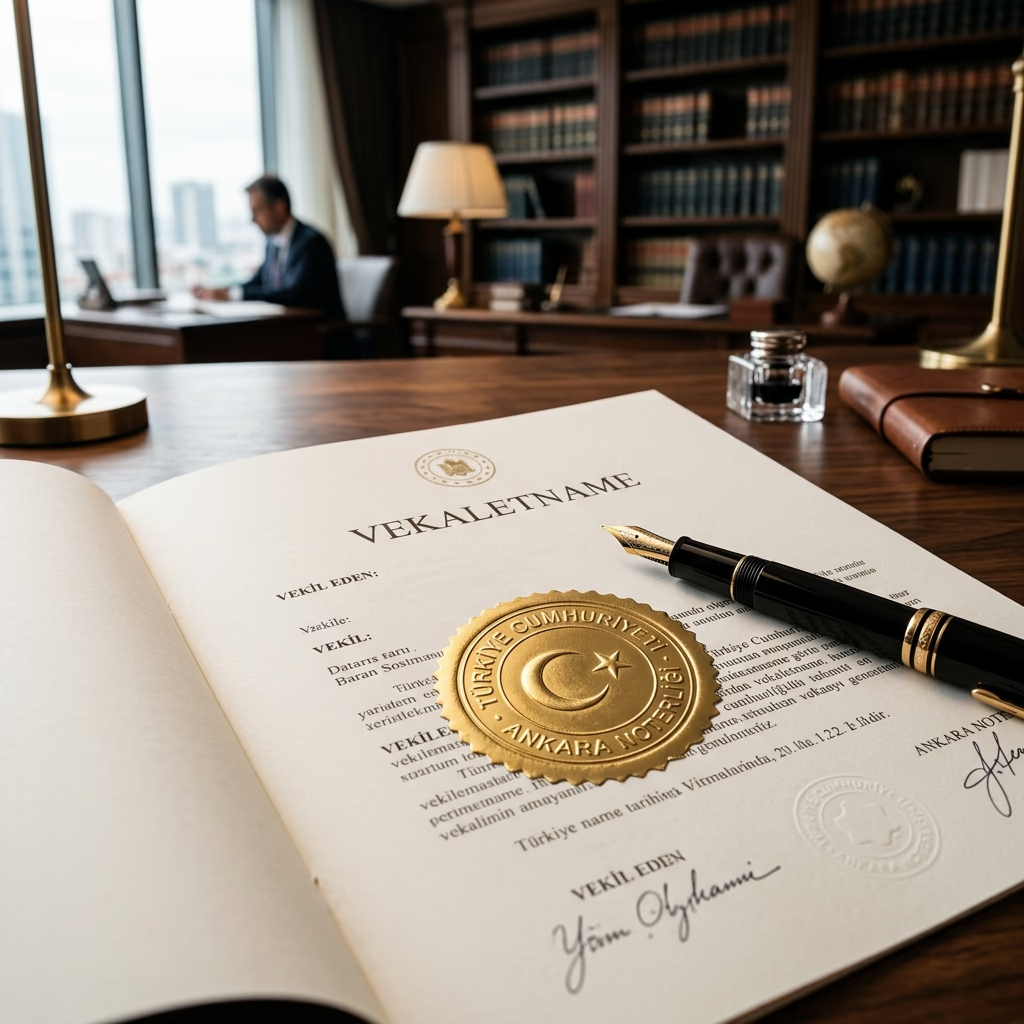
The closest thing to a Turkish notary in Germany is the Turkish consulate. Consulates perform notarial functions under Turkish law. A power of attorney issued there is created directly under Turkish notarial law and recorded in the Türkiye Noterler Birliği database.
In practice this means: a consulate power of attorney needs no apostille, needs no certified translation, and is accepted directly by Turkish courts, land registries and banks. For legally sensitive matters — property transfer, inheritance, divorce, recognition/enforcement (Tanıma-Tenfiz) — this is the safest route.
Turkey maintains consulates in 13 German cities: Berlin, Düsseldorf, Cologne, Essen, Frankfurt, Hamburg, Stuttgart, Hanover, Karlsruhe, Mainz, Munich, Münster and Nuremberg. (If you live in the UK, the Netherlands or elsewhere, the same logic applies: your nearest Turkish consulate performs this function.)
⚠️ Important: Consulate appointments can be booked out weeks in advance during busy periods. If your matter in Turkey has a deadline (a hearing, a land-registry appointment), plan ahead — or use Route 2.
Route 2: German notary + apostille + translation
The second route runs through a German notary (or a notary in your country of residence). They can certify a power of attorney intended for use in Turkey. On its own, that is not enough.
For Turkey to accept it, two more steps are required. First, an apostille — an international certification under the Hague Convention confirming the notary's signature is genuine. In Germany, the apostille for notarial deeds is obtained from the competent Higher Regional Court (Oberlandesgericht). Second, a certified Turkish translation — the apostilled document must be translated into Turkish by a sworn translator and notarised in Turkey.
One crucial point: a German notary has no Turkish power-of-attorney templates. You must prepare the text yourself, compliant with Turkish law, and bring it. This is exactly where most people come unstuck.
The most expensive mistake: a German notary deed with no apostille
By far the most common mistake is going to a notary, having the power of attorney certified, and sending it straight to Turkey — without an apostille.
The result: the Turkish land registry, court or bank rejects it. The whole process starts over. Time and money lost, and in the worst case a deadline in Turkey passes.
⚠️ Important: A notarial power of attorney is worthless in Turkey without an apostille. Always confirm the apostille and certified translation are in place before you send anything to Turkey.
Consulate or German notary — which is better?
| Criterion | Turkish Consulate | German Notary + Apostille |
|---|---|---|
| Apostille required? | No | Yes |
| Turkish translation required? | No | Yes |
| Appointment lead time | Often 2–4 weeks | Usually 1–2 weeks |
| Directly valid in Turkey? | Yes | Yes (with apostille + translation) |
| Recommended for | Property, inheritance, divorce, Tanıma-Tenfiz | Urgent cases or when a consulate is hard to reach |
Rule of thumb: if you have time, use the consulate. If it's urgent or the nearest consulate is far away, the notary + apostille route is just as secure — provided the wording is correct.
The real failure point: the wording of the power of attorney
Whether consulate or notary, the real risk isn't the signing — it's the content of the document. Turkish courts and offices check carefully whether the powers granted are sufficient.
For a Tanıma-Tenfiz power of attorney (recognising a foreign divorce in Turkey), the text must expressly authorise "filing and pursuing a recognition and enforcement action at every stage." For a property power of attorney, the land-registry details of the property (ada, parsel, il, ilçe) must appear in the text, and it must be in "deed form" (düzenleme şekli). For a lawyer's power of attorney, the lawyer's name, bar association and bar registration number must be correct.
So the real question isn't "Where's a Turkish notary?" but "Who will draft a power of attorney that Turkey won't reject?"
How Doğru Kanzlei handles this
Doğru Kanzlei holds dual bar membership with the Ankara Bar Association (registration no. 47068) and the Karlsruhe Bar Association (§ 207 BRAO). That means we draft the power-of-attorney text under Turkish law, tell you exactly what to bring to the consulate or notary, coordinate the apostille and translation, and then represent you directly before Turkish courts and authorities — with no relay through a third lawyer in Turkey.
So you don't need to find a "Turkish notary." You need a Turkish lawyer who drafts the document correctly and finishes the matter in Turkey.

Done-for-you power of attorney process
We prepare your Turkey power of attorney with you
Use the WhatsApp intake form to explain what the document is for. Hasan Doğru checks the route, wording, apostille, translation and next steps.
What we handle
- Route check: Turkish consulate or German notary with apostille
- Purpose-specific Turkish wording for property, inheritance, bank, court or authorities
- Next-step coordination until the document can be used in Turkey
German, Turkish and English · Turkish law · Mannheim & Ankara