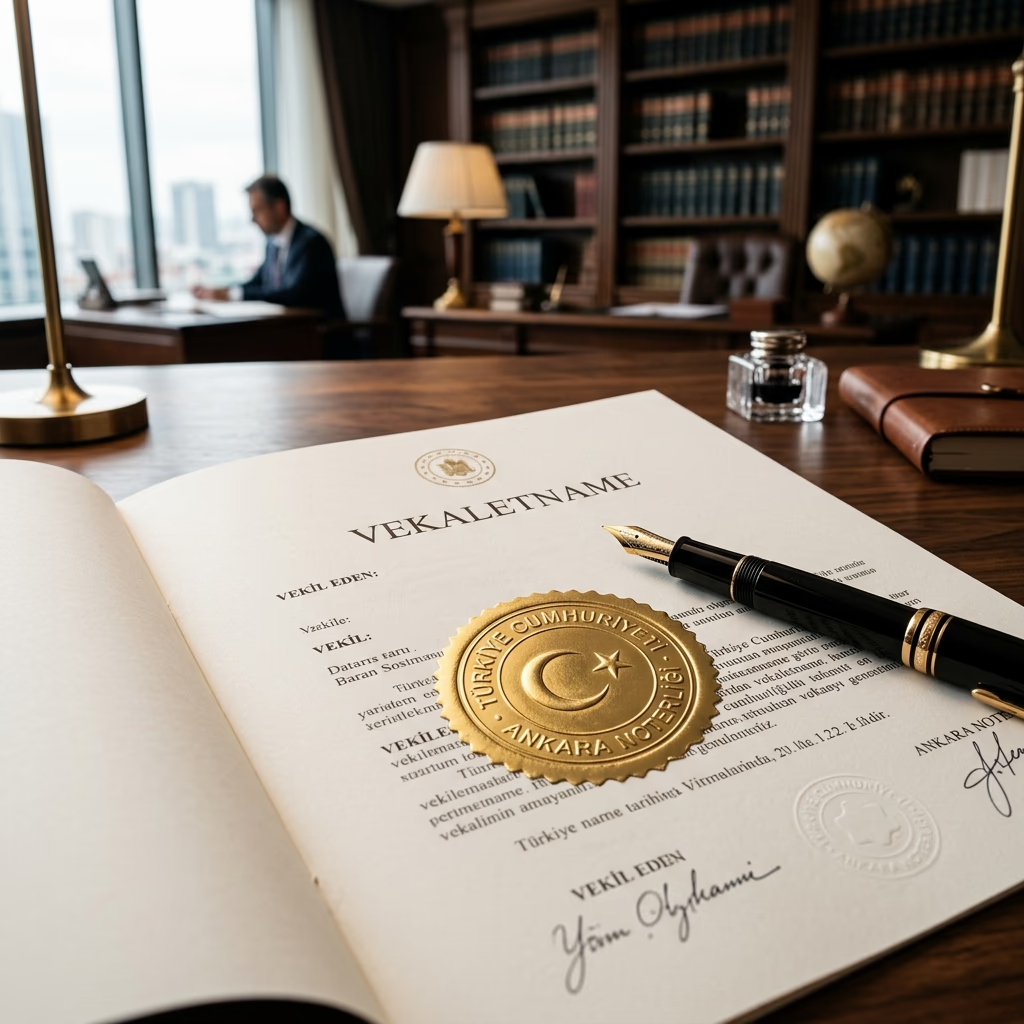
Turkey’s 12th Judicial Package changes the first auction round for inherited property. This guide explains when the new 100% rule applies and why valuation, objection deadlines and deposits must be checked early.
- Heirs and title deed: when is the first auction limited to co-heirs?
- Valuation and objections: why a missed deadline can become expensive
- Bidding from abroad: power of attorney, UYAP, deposit and 7-day payment deadline
Av. Hasan Doğru · Turkish inheritance law · Mannheim & Ankara
This article addresses Turkish law exclusively. Doğru Kanzlei advises on Turkish law under § 207 BRAO and does not advise on German domestic law.
Updated: 30 July 2026 · This article is based on the text of the 12th Judicial Package as passed by the Turkish Parliament (TBMM) on 16 July 2026. As of writing, the law had not yet been published in Turkey’s Official Gazette (Resmî Gazete); it takes effect on the date of publication.
On auction day, the court’s expert had valued the field at the equivalent of about £45,000. But the auction opened at half that value — around £22,500. A local contractor you’d never met bought the field for roughly £24,000 — nearly half its real worth. You received your share of that low price. Your grandfather’s field now belongs to a stranger.
This scenario played out for thousands of families in Turkey, year after year. And honestly, as lawyers, we often had to tell clients: “Unfortunately, that’s how the law works.”
That has now changed — and the change matters most for people exactly like you: living abroad, trying to protect property in Turkey from a distance.
Why This Matters if You Have Family Property in Turkey
Millions of people with Turkish family roots now live across the UK, the Netherlands, Scandinavia, the US, and Australia. A piece of land, a vineyard, or an apartment left behind in Turkey often stays jointly owned by the whole family. With each generation, the number of heirs grows, and everyone has different priorities. That’s what makes disputes over jointly-owned inherited property one of the most common legal issues facing the Turkish diaspora.
One thing worth understanding upfront: proving your status as an heir in your home country typically works through your local system — a Grant of Probate in the UK, for instance. But for property located in Turkey, you also need a Turkish certificate of inheritance (called a “Veraset İlamı”), issued by a Turkish court. The entire process concerning the property is governed by Turkish law, regardless of where you live or what documents you hold at home. This is why the process described in this article runs entirely through the Turkish court system, not through your local probate process.
What Is the “Assessed Value” and Why Does It Matter So Much Now?
The “muhammen bedel” (assessed value) is the estimated market value that a court-appointed expert assigns to a property — the official answer to the question “what is this land, this apartment, actually worth?” The expert is usually chosen from the official list of experts registered with the relevant court, inspects the property in person, checks the land registry and zoning status, and compares recent sales of similar properties in the area.
Under the old system, the problem was straightforward: the auction only had to open at 50% of that assessed value. So for a property worth the equivalent of £90,000, bidding could open at £45,000. That gap was a paradise for opportunists. While families were busy disagreeing among themselves, an outsider could walk away with the property at half its real value.
Turkey’s 12th Judicial Package changed the Enforcement and Bankruptcy Law (İcra ve İflas Kanunu) at exactly this point: under certain conditions, the first auction must now open at 100% of the assessed value. In other words, no more below-market sales — at least not in the first round.
Important: This 100% rule does not apply to every auction. It only applies to properties meeting the two conditions described in the next section. If a property doesn’t meet both conditions, the old 50% rule can still apply.
Which Properties Qualify for This New Protection?
The new rule only applies when both of the following conditions are met together — and this is exactly where most people get confused.
First, every single owner of the property must have acquired their share through inheritance. In other words, ownership must have passed to the heirs as a result of a death; if any share was later acquired through a purchase, this condition is broken.
Second, no third party outside the circle of heirs may hold any ownership right in the property. If a co-heir has already sold part of their share to an outsider, the protection doesn’t apply.
If both conditions are met: the first auction is limited strictly to the co-owner heirs. Outsiders cannot participate. Bidding starts at 100% of the assessed value plus sale costs.
In practical terms: for your grandfather’s field, only you and your siblings can now bid in the first auction. The local contractor is locked out. One of you can pay the real value and keep the field in the family.
A worked example: suppose three heirs — you, your sister, and your cousin — inherited a plot valued at the equivalent of £150,000. If all three shares came directly through inheritance and no outsider owns any part of it, the first auction opens at £150,000, and only the three of you can bid. But if your cousin sold part of his share to a neighboring farmer years ago, the property no longer qualifies for this protection, and the auction reverts to the old, publicly-open process. That’s exactly why checking the current land registry (Tapu) record before starting a case is essential.
What Happens if None of the Heirs Buy?
Then the second auction kicks in, and it’s open to the public. At that point, outside buyers can bid, and the sale proceeds under the general rules.
But note this: because the first round now opens at real market value, the family is effectively being told, “decide — pay the real price and keep it, or let it go.” The choice belongs to the family, not to whoever happens to be waiting outside with cash.
There’s a related, common problem worth flagging here: some heirs want to sell, others want to keep the property. The 100% starting bid doesn’t automatically favor the heir who wants to keep it — it simply removes the unfair advantage an outside buyer used to have. Disagreement between heirs themselves is a separate issue and usually requires its own negotiation or litigation strategy.
The Most Common Mistake: Missing the Deadline to Challenge the Valuation
However strong this new protection is, one procedural mistake can undo all of it: missing the deadline to formally challenge the expert’s valuation report.
Here’s how it works. The court appoints an expert, who inspects the property and produces a report. Once that report is formally served on the parties, there’s a short window to object to it. If nobody objects within that window, the report becomes final — and the assessed value is locked in. Even the 100% rule can’t protect you if the expert undervalued the property and nobody challenged it in time; 100% of a number that’s already too low is still too low.
For heirs living abroad, this risk is amplified. Official notices sometimes get sent to an address in Turkey — a relative’s home in the village, for example — and simply don’t get passed along in time. The deadline passes, and the right to object is gone.
Important: The deadline to challenge the expert valuation report is short and is generally not reopened once missed. Giving power of attorney to a lawyer who actively monitors the case is the most reliable way to avoid losing this right.
Deposits, Payment Deadlines, and Penalties: Who Pays What, and When
Another key part of the reform concerns who can participate in the auction and under what conditions. The table below compares the old and new rules:
| Issue | Old Practice | Under the 12th Judicial Package |
|---|---|---|
| Minimum bid, first auction | 50% of assessed value | 100% of assessed value (for qualifying heir-owned property) |
| Who can bid in the first auction | Anyone | Only co-owner heirs (if conditions are met) |
| Deposit requirement for co-heirs | Could bid without a deposit | Deposit required, same as third parties |
| Deadline to pay the winning bid | Delays were common in practice | No later than 7 days from notice |
| Penalty for non-payment | Loss of deposit | Loss of deposit + fine of 5% of the winning bid |
| Time allowed between hearings (HMK Art. 147) | Often 6–8 months in practice | Generally capped at 3 months |
Important: The winning bidder must pay the full auction price within 7 days of the auction record being published on the e-sale portal. Missing this deadline means losing the deposit and paying an administrative fine equal to 5% of the winning bid.
To put a number on it: on a winning bid of roughly £24,000, a buyer who fails to pay in time would lose their deposit and face a fine of around £1,200 — a penalty deliberately set high enough to discourage reckless or bad-faith bidding.
The reasoning behind the new deposit rule: previously, co-heirs could bid without posting any deposit. That allowed a bad-faith heir to sabotage the process — bid high, win the auction, then simply not pay, freezing the whole case. Under the new system, every co-heir who wants to bid must post a cash deposit or bank guarantee, just like outside bidders. The only exemption applies to a creditor whose claim already covers the deposit. The result: only people who are genuinely ready to buy, and have the funds ready, remain at the table.
Why the Gap Between Hearings Matters So Much
One of the quietest but most impactful changes in the 12th Judicial Package is the amendment to Article 147 of the Code of Civil Procedure (HMK). The most exhausting part of a Turkish court case is often not the case itself — it’s the waiting between hearings. One hearing takes place, and the next is scheduled six or eight months later. For someone following a case from abroad, that means years of open-ended uncertainty.
Under the new rule, in written proceedings, the gap between hearing dates set by the court generally cannot exceed 3 months. In exceptional cases the judge may set a longer gap, with justification — but that’s meant to be the exception, not the norm.
For a client following a case from London, Amsterdam, or Stockholm, the practical meaning is simple: less waiting, less uncertainty, faster resolution. This rule doesn’t just apply to partition-sale cases — it applies to nearly all civil proceedings, including divorce cases.
What Else Changed, Including Divorce Cases
The package is broad. Beyond inheritance and property law, it touches many other areas. On family law and general procedure, the highlights are:
The new 3-month cap between hearings will speed up divorce cases too, along with nearly every other type of civil case. The months-long waits between hearings that many divorce cases in Turkey have historically involved should shrink — directly relevant for many of our clients living abroad with a pending divorce case in Turkey.
The package also includes numerous technical changes to enforcement law, criminal procedure, administrative litigation, and statutory interest rates. Which of these actually matters for your file can only be assessed by looking at your specific situation. For more on cross-border inheritance issues generally, see our Turkish Inheritance Guide for Germany.
A Step-by-Step Roadmap for Managing This From Abroad
It’s entirely possible to manage this process without traveling to Turkey — provided certain steps are taken in the right order and on time:
Get a power of attorney. One issued at a Turkish consulate, or drawn up before a notary in your home country and apostilled, authorizes your lawyer to represent you before Turkish courts and enforcement offices.
Establish where the case stands. If no case has been filed yet, the correct court needs to be identified. If a case is already underway, check whether the valuation report has already been produced.
Track the deadline to challenge the valuation. If the expert’s report undervalues the property and nobody objects in time, that low value becomes final. Even a single day’s delay can cost you this right.
Prepare your deposit if you plan to bid. A cash deposit or bank guarantee needs to be ready before the auction date — transfers from abroad take time, so start this well in advance.
Track the auction result and the 7-day payment deadline. If you or another heir wins the auction, your lawyer should monitor via UYAP whether payment is made on time.
Keep track of hearing dates. Thanks to the new 3-month cap, the process is now more predictable; your lawyer should update you after every hearing with the next scheduled date.
Plan for costs and fees early. Court fees, legal fees, and potentially inheritance-related taxes may apply to the proceeds of the sale; clarifying these with your lawyer at the outset avoids surprises later.
What This Means for an Heir Living Abroad
Back to where we started. You’re that person living abroad. You’ve inherited a share of property in Turkey, and you can’t agree with the other heirs on what to do with it.
In the past, we’d have told you: “Let’s file the case, but the property could sell below its real value at auction, and an outsider could walk away with it.” A genuinely risky picture.
Today, that picture has changed. Now:
The family property no longer goes to a stranger in the first auction — if the property qualifies, only you and your co-heirs can bid.
The property is offered at its real value — no more selling at half price.
The process moves faster — the gap between hearings generally can’t exceed 3 months.
Bad-faith bidders are filtered out — the new deposit rule removes the incentive to sabotage the auction.
But we should be equally honest about this: taking advantage of these protections requires acting correctly and on time. Preparing a deposit, tracking the valuation process, and challenging the valuation report within the deadline if needed — these are all technical, time-sensitive tasks. A single day’s delay can cost you your rights.
This Article Is Especially for You If
You’re a co-owner of inherited property in Turkey and can’t reach agreement with the other heirs.
A co-heir has filed a case to force the sale of shared property, and you’re not sure what to do next.
You’re worried your family’s property will be sold for less than it’s worth.
You live abroad and want to manage this process without repeated trips to Turkey.
How Doğru Kanzlei Can Help
As a lawyer registered with the Ankara Bar Association and also a member of the Karlsruhe Bar Association in Germany (§ 207 BRAO), I handle partition-sale cases in Turkey directly for heirs who live abroad. I am also registered as a Turkish law expert on the official expert list of the Mannheim Local Court (Amtsgericht Mannheim) in Germany — meaning the same person can follow your file on both the Turkish and the German side.
There’s no intermediary lawyer, no chain of translators. I follow your case in real time through Turkey’s UYAP e-court system and manage the auction process, the valuation, and the deposit requirements from outside Turkey. You stay wherever you live, and I handle everything on the ground in Turkey. Having spent close to ten years with the Turkish National Police’s Special Operations unit (Özel Harekat) before becoming a lawyer, I bring a practical understanding of how Turkish administrative and enforcement authorities actually operate — useful when service of documents or enforcement steps need to be tracked closely.
For more on our inheritance law services, see our inheritance law page. If a German court, law firm, or notary needs a written expert opinion on Turkish law, see our expert legal opinion on Turkish law.
The initial assessment is free. Tell us about your situation, and we’ll give you a realistic roadmap.
Request a Free Initial Assessment with Doğru Kanzlei →
Also Available in Other Languages
This guide is also available in Turkish:
12. Yargı Paketi: Miras Malı Artık Yabancıya Gitmiyor →
And in German for German-speaking family members or advisers:
Das geerbte Grundstück ging an einen Fremden. Das 12. Justizpaket ändert das. →

Done-for-you partition auction review
We review your Turkish inherited property before auction
Use the WhatsApp intake form to explain the property, heirs and current stage. Hasan Doğru reviews the title deed, inheritance documents, valuation, objection deadlines, deposit and auction strategy without unnecessary travel.
What we handle
- Review of title deed, heir structure and 100% rule eligibility
- Check of valuation report, objection deadline and auction date
- Coordination of power of attorney, UYAP, deposit and bidding strategy
Turkish inheritance law · Mannheim & Ankara · UYAP file control